
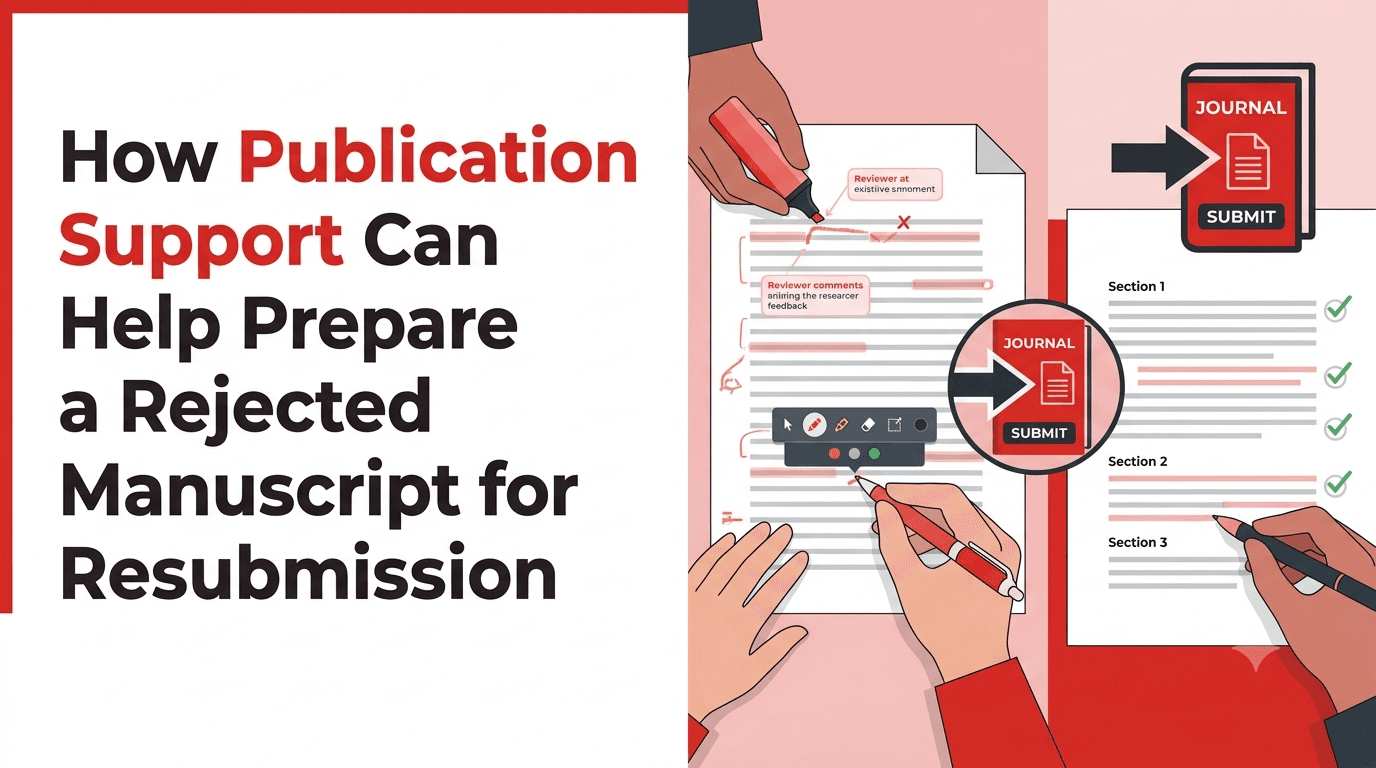
How Publication Support Can Help Prepare a Rejected Manuscript for Resubmission
Rejection of a research paper from a journal is an undesirable situation. The study may take months of work by the researchers, analyzing the data, writing the study and preparing it for submission. After all that work getting a journal to accept your submission, it's discouraging to get a rejection.
But then again, a rejected manuscript doesn't necessarily imply that the research has no publication value. Sometimes the problem is related to the way the research is presented, the clarity of the methodology, the literature review, the journal selected, or the way reviewer concerns were addressed.
It is better to learn from the way the paper has failed to be accepted by the first journal and make the necessary improvements before sending the same paper to another journal at once. In this regard, support services for the publication can be of assistance.
With proper academic publication assistance, researchers could see the rejection letter, analyse the feedback from the reviewers, find out the gaps, enhance the paper, select the right journal and prepare the paper for submission.
What Does a Journal Rejection Mean?
There are various stages when a manuscript can be rejected. This is because the reasons for rejection indicate what the researcher should do next.
Desk Rejection
A Desk Rejection is the rejection of a manuscript by an editor before it is referred out for external peer review.
Some common reasons include:
- The manuscript does not fit the journal's scope.
- The research contribution is not clear.
- The article does not match the journal's readership.
- The manuscript does not follow basic submission requirements.
- The paper has major presentation or language problems.
- The study may not be sufficiently relevant or novel for that journal.
It is not always a sign of shoddy research if it is rejected on desk. Sometimes it may be that the manuscript was submitted to a journal that was not the appropriate match.
Rejection After Peer Review
A manuscript could also be rejected following the evaluation by one or more reviewers.
In such a case, the decision could involve:
- Weak methodology
- Inadequate analysis
- Gaps in the literature review
- Unclear research objectives
- Limited explanation of the research contribution
- Poor presentation of results
- Unsupported conclusions
- Problems with the manuscript's structure
While this may be disappointing, the comments of the reviewers can also be valuable in helping enhance the paper.
Rejection With an Invitation to Resubmit
Sometimes, an editor will suggest that the revised version may be submitted for further consideration.
This should not be interpreted the same as a final rejection. The author is requested to read very carefully the editor's decision and to follow the instructions given before preparing the next submission.
Should You Submit the Same Manuscript to Another Journal?
The easiest error to commit after rejection is to change the journal name and resubmit the same manuscript.
Changing to a different journal won't fix a problem that reviewers have already noticed.
For instance, if the methodology is not clear, the same concern could be raised at the next journal. The research contribution, if difficult to comprehend, may be difficult for another editor to see its value either.
A better way is:
This allows researchers to learn from the first decision rather than having to deal with the same problems again.
What Are Publication Support Services?
Publication support services help in various phases of research publishing. With a manuscript previously rejected, the emphasis is typically on why the manuscript failed to meet the standards of the journal and how it can be improved in a new submission.
In addition to authoring publications, a researcher might receive the following kinds of support for their publications:
- Reviewing the rejection decision
- Analysing reviewer comments
- Assessing the overall manuscript
- Identifying major and minor problems
- Reviewing methodology and analysis
- Strengthening the literature review
- Improving the research contribution
- Academic language editing
- Reference and citation checking
- Journal selection
- Journal formatting
- Cover-letter preparation
- Response-to-reviewer preparation
- Final submission checks
The aim of publication assistance should be not to guarantee acceptance. The job of this is to give the researcher a better idea of what needs to be improved and how the manuscript should be made more suitable for its next submission.
How Publication Support Helps Analyse Reviewer Feedback
Reviewer comments can sometimes be difficult to understand, especially for researchers who are relatively new to academic publishing.
For example, a reviewer may say that the methodology needs more clarification. But what exactly does that mean?
The researcher may need to explain the research design, sampling method, data collection process, variables, analytical method, or another part of the study.
This is where structured publication support can help turn general reviewer comments into specific revision tasks.
| Reviewer Feedback | What It May Indicate | Possible Revision |
|---|---|---|
| Methodology needs clarification | Research methods are not sufficiently explained | Expand the methodology section |
| Literature review is incomplete | Important research may be missing | Add and connect relevant literature |
| Contribution is unclear | The research gap is not clearly presented | Strengthen the research gap and contribution |
| Results are not convincing | Analysis or interpretation may need attention | Review results and their interpretation |
| Conclusions are too broad | Claims may go beyond the evidence | Narrow and support the conclusions |
| Language needs improvement | Ideas may be difficult to follow | Carry out academic language editing |
This approach makes manuscript revision more organised and helps researchers focus on the issues that matter most.
Major and Minor Problems Need Different Approaches
Not every reviewer comment requires the same amount of work.
A minor change will correct a spelling mistake, for example. Modification of a research methodology may be significant.
Major issues may include:
- Weak research design
- Methodological concerns
- Insufficient analysis
- Missing important literature
- Unclear research objectives
- Weak research contribution
- Unsupported conclusions
- Problems with interpretation
Minor issues may include:
- Grammar
- Spelling
- Formatting
- Citation inconsistencies
- Figure captions
- Terminology
- Small structural corrections
This is significant because sometimes researchers tend to correct the language and miss the underlying academic issues.
A well polished manuscript is not necessarily a good manuscript. The research itself should be clearly and appropriately presented.
How Publication Support Can Strengthen a Rejected Manuscript
Once the reviewer feedback has been understood, the next step is to revise the manuscript.
The revision could be made to several parts of the paper.
Strengthening the Introduction
The introduction should draw the reader to the understanding of:
- What is already known?
- What is still missing?
- Why is the current study needed?
- What does the study contribute?
If it is hard to find a gap in the research, then the introduction can be re-structured to make the purpose of the research much clearer.
Improving the Literature Review
The literature review should not be just a compilation of past research.
It should indicate the relation of the work already conducted to the current research and the gap in the research.
Researchers may have to:
- Add relevant studies
- Remove unnecessary information
- Connect related findings
- Identify gaps more clearly
- Explain how the current study addresses those gaps
Reviewing the Methodology
A rejected paper could require more than editing, especially if it has a problem with methodology.
The manuscript should clearly explain relevant details such as:
- Research design
- Study population or sample
- Data collection
- Variables or measures
- Research procedures
- Data analysis
- Limitations
If reviewers have indicated a methodological issue, the researcher should decide if further explanation of the methodology is sufficient or if the research is in need of further development.
Improving Results and Discussion
It's important to present the findings of the study clearly.
The discussion should provide an explanation of those findings, and relate them to other research.
A revision may be required if:
- Results are difficult to understand.
- The discussion simply repeats the results.
- Findings are not connected with previous research.
- Claims are stronger than the evidence.
- The conclusion does not properly reflect the findings.
Manuscript Editing Is Important, But It Is Not the Whole Revision
Once the significant academic problems are resolved, then manuscript editing can help to enhance the presentation of the research.
Editing can help with:
- Grammar
- Sentence structure
- Academic language
- Clarity
- Paragraph flow
- Repetition
- Consistent terminology
- References
- Tables and figures
- Captions
However, editing and revision are not the same thing.
The editing process contributes to the better communication of the research.
Revision enhances the manuscript.
An example of this would be the act of making an unclear sentence clearer: editing. Substantive revision involves changing an unsupported conclusion that is made again, after rethinking the research results.
Either can be needed before a rejected manuscript is ready for resubmission.
How Publication Support Can Help With Journal Selection
It's not just the manuscript that is the problem sometimes. It's possible that the original journal wasn't a good fit.
Researchers should take into account:
- Journal scope
- Subject area
- Target readership
- Article type
- Recently published papers
- Word limits
- Formatting requirements
- Reference style
- Submission policies
- Publication model
It is not intended to seek any journal that will accept it.
The idea is to seek a journal that is well aligned with the research topic, contribution, type of article and its audience.
It is a very significant component of the journal submission support since a paper that is resubmitted to an inappropriate journal may be rejected again.
How to Adapt a Manuscript for a New Journal
What works for one journal might not work for another.
The new journal may have different requirements for:
- Title
- Abstract
- Keywords
- Manuscript structure
- Word count
- Reference style
- Figures and tables
- Author information
- Declarations
- Supplementary files
The title and abstract also might require some changes in order to make the research contribution understandable to the audience of the new journal.
That is why the resubmission of journals must not be just simply uploading the same manuscript.
The revised paper should be read through the guidelines for authors of the revised journal before submission.
How to Handle Conflicting Reviewer Comments
Not always reviewers are in accord.
For example:
Reviewer 2: The literature review is already too long.
This may leave the researcher with a dilemma as to which comment is to be used.
Preferring one reviewers over another, rather, it can be helpful to identify the root cause of the issue. Maybe the literature review is long, but still it doesn't concentrate on the best studies.
If so, a possible solution is to re-organise the section, delete any unwanted material and bolster the existing literature.
Researchers may not concur with all of the comments from the reviewers. They should then clearly and professionally explain their reasoning in this case instead of ignoring the concern.
Preparing a Response to Reviewer Comments
A journal may request a response to the reviewers when it requests a revised submission.
Simpler structures are:
For example:
| Reviewer Comment | Author Response | Change Made |
|---|---|---|
| Methodology needs more detail | The methodology has been expanded | Additional explanation added |
| Literature review is incomplete | Relevant studies were added | Literature review updated |
| Conclusion is too broad | The conclusion was revised to reflect the findings | Conclusion narrowed |
A clear response helps the editor see how the manuscript has changed.
It also gives researchers a way to make sure that important reviewer comments have not been forgotten.
Should You Return to the Same Journal or Choose Another?
There are no definitive rules for every rejected manuscript.
Returning to the same journal may make sense when:
- The editor has invited resubmission.
- The journal remains a strong fit.
- Reviewer concerns can realistically be addressed.
- The decision provides a clear opportunity for revision.
Choosing another journal may be better when:
- The manuscript does not fit the journal's scope.
- The rejection is final.
- The target readership is not appropriate.
- Another journal is a much better match.
- The manuscript has been substantially revised and is now better suited elsewhere.
The decision should always be based in the Journal decision letter and Journal policies.
Preparing the Cover Letter for Journal Resubmission
A new cover letter may also be required if you submit a revised letter.
The cover letter should be short and concise, providing a brief explanation of:
- Manuscript title
- Article type
- Main research contribution
- Why the paper fits the journal
- Important improvements made, where relevant
When the text is submitted to the same journal for revision, the letter may briefly remind the reviewers of the major revision changes in the text that have been made due to the previous feedback.
When the journal is a new one, then the emphasis should be on the research contribution and fit with the journal.
A Complete Publication Support Workflow
The process can be much easier to go through when done in a structured manner.
Learn the reasons for the manuscript's rejection and finality of the rejection.
Sort out major issues, minor corrections and conflicting comments.
Ignore the comments of reviewers and pinpoint areas of weakness in the structure, methodology, literature, analysis, and presentation.
Focus on changes that are most significant for improving the manuscript.
Enhance the areas addressed and substantive concerns.
Enhance language, clarity, references, tables, figures and presentation in general.
Determine if the same journal is suitable, or if a different journal is a better option.
Follow each selected journal's author guidelines and formatting.
Fill in cover letter, response, declarations, figures and other needed files.
Go through the entire submission before re-submitting.
This workflow helps transform the journal paper reject to resubmit process into a well-defined process.
Common Mistakes When Resubmitting a Rejected Manuscript
Copying the same paper with very little to no changes made
Focusing only on grammar
Better language cannot compensate for weak methodology, poor analysis, or an unclear research contribution.
Ignoring difficult reviewer comments
Rather than skirt around difficult comments, the issues should be broken down and addressed.
Choosing a journal simply because it accepts submissions
The way the journal fits is crucial. All of these factors should be taken into account: topic, audience, article type, scope.
Forgetting to update related sections
The results, discussion, abstract and conclusion should also be reviewed if the methodology changes.
Assuming rejection means the research has no value
Rejection may be an indicator of fit with the journal, presentation or weaknesses and not necessarily a sign that the research project is not of value.
When Is Publication Assistance Useful?
Not every researcher needs professional support after a rejection. Some authors can work through reviewer feedback with their co-authors, supervisors, or colleagues.
But publication assistance may be helpful when:
- Reviewer comments are difficult to interpret.
- Different reviewers have conflicting opinions.
- The paper has received repeated rejection.
- Major methodological concerns have been raised.
- The research contribution is unclear.
- The manuscript needs extensive restructuring.
- Language problems affect readability.
- The researcher is unsure which journal to choose.
- Submission requirements are complicated.
- The researcher wants an independent assessment before resubmission.
The role of support is to augment the researcher's knowledge and judgment skills, not supplant them.
What Publication Support Cannot Do
You should have realistic expectations of your publication support services.
Any reputable support provider cannot give an absolute assurance to the author that a manuscript or paper will be accepted for publication in a journal.
A publication support can help to improve:
- Manuscript clarity
- Academic presentation
- Reviewer responses
- Journal selection
- Formatting
- Submission readiness
However, the final decision rests with the Editor and/or Reviewers of the journal.
The actual importance of support is that it enables the researcher to submit a better manuscript that is stronger, clearer, well-revised, and better prepared.
Final Checklist Before Journal Resubmission
Prior to submission of revised paper to a journal, consider the following areas.
Research Quality
- Is the research question clear?
- Is the methodology adequately explained?
- Are the results properly presented?
- Do the conclusions match the findings?
- Is the research contribution clear?
Reviewer Feedback
- Have all major comments been addressed?
- Have minor corrections been completed?
- Have conflicting comments been considered?
- Does the response document match the changes in the manuscript?
Manuscript Quality
- Is the language clear?
- Is the structure logical?
- Are tables and figures properly presented?
- Are references consistent?
- Have all sections been checked after major revisions?
Journal Requirements
- Does the manuscript fit the journal's scope?
- Is the article type correct?
- Does the paper follow the author guidelines?
- Are all required declarations included?
- Are formatting requirements complete?
Final Submission
- Is the cover letter ready?
- Are all required files included?
- Are the final files correct?
- Has the complete submission package been reviewed?
FAQs
Can I resubmit a rejected manuscript to another journal?
Yes. Once the previous journal has made its final decision, the revised manuscript can generally be submitted to another suitable journal. However, it is better to address the weaknesses identified during the first submission before starting the next one.
Should I revise a manuscript before choosing another journal?
It is usually helpful to understand the rejection first. Some problems may be related to the manuscript itself, while others may be related to journal fit. Identifying the difference can help you revise the paper and select a more suitable journal.
Can publication support guarantee acceptance?
No. Publication support services cannot guarantee journal acceptance. They can help improve the manuscript, address reviewer concerns, select a suitable journal, and prepare the submission, but the final decision belongs to the editor and reviewers.
Is manuscript editing enough after a journal rejection?
Not always. If the rejection involves methodology, analysis, literature, or research contribution, deeper manuscript revision may be necessary. Language editing is only one part of preparing a rejected paper for resubmission.
What should I do if reviewers give conflicting feedback?
Look for the underlying issue behind the comments instead of following one comment blindly. Discussing the feedback with a supervisor, co-author, or experienced researcher can also help. If you disagree with a reviewer, explain your reasoning clearly and professionally.